

 Français



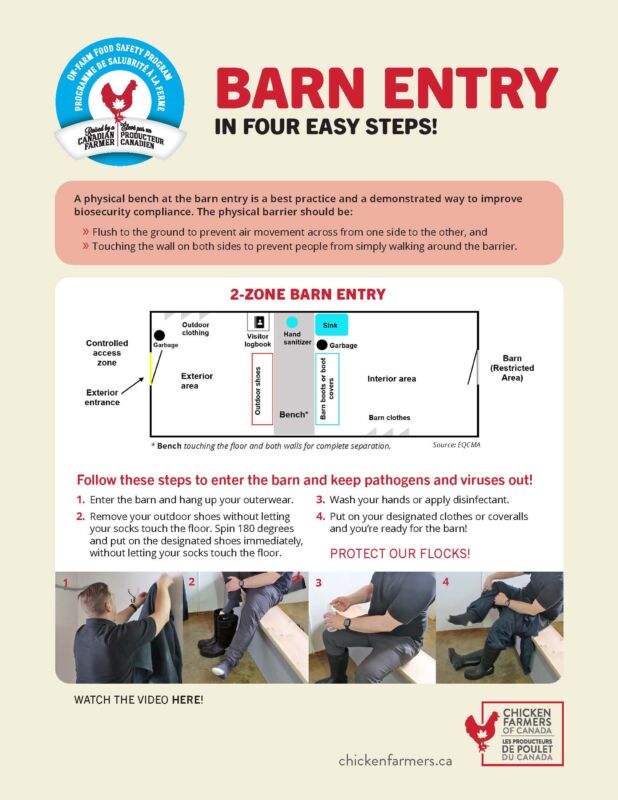
At their December meeting, CFC Directors made the decision to increase the minimum entrance requirements for barns, making physical barriers (e.g. bench or a step-over) mandatory between the Controlled Access Zone and the Restricted Area.
More information will be shared in 2026 as CFC Directors finalize the requirement text and the implementation date.
CFC is communicating to members prior to a decision on an implementation date as farmers are strongly encouraged to have this in place prior to the next high-risk period for Highly Pathogenic Avian Influenza (HPAI) – which is the Spring of 2026 at the start of period A-201.
Over the last four years, HPAI has caused widespread infections, resulting in sector-wide impacts, including economic losses, production issues and trade restrictions.
During this on-going threat of HPAI, CFC has been re-assessing biosecurity programming by reviewing scientific literature and epidemiological reports on HPAI infections.
Based on this review, a “clearly identified line” is no longer sufficient given the risk of HPAI infections, what we know and have learned about how pathogens may enter the barn, and the impact that these events have on the sector as a whole. Even if boot changes are done properly, using a “clearly identified line” does not prevent dust and debris, which can contain harmful viruses and bacteria, from blowing across and contaminating the Restricted Area.
There are a number of ways that HPAI and other pathogens can enter a barn, either by physical movement (e.g. via personnel, equipment or pests) or through windborne spread. While there is no silver bullet solution to preventing HPAI infections, or bacterial infections (e.g. Salmonella, Campylobacter, E.coli) from a food safety perspective, it is in the best interest of the sector to implement a properly designed and used physical barrier to limit these hazards to the flock.
Effective physical barriers should:
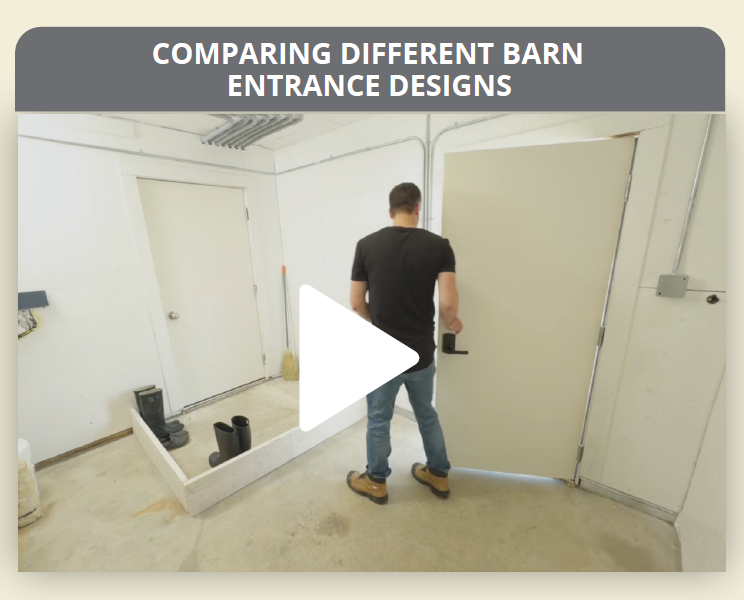
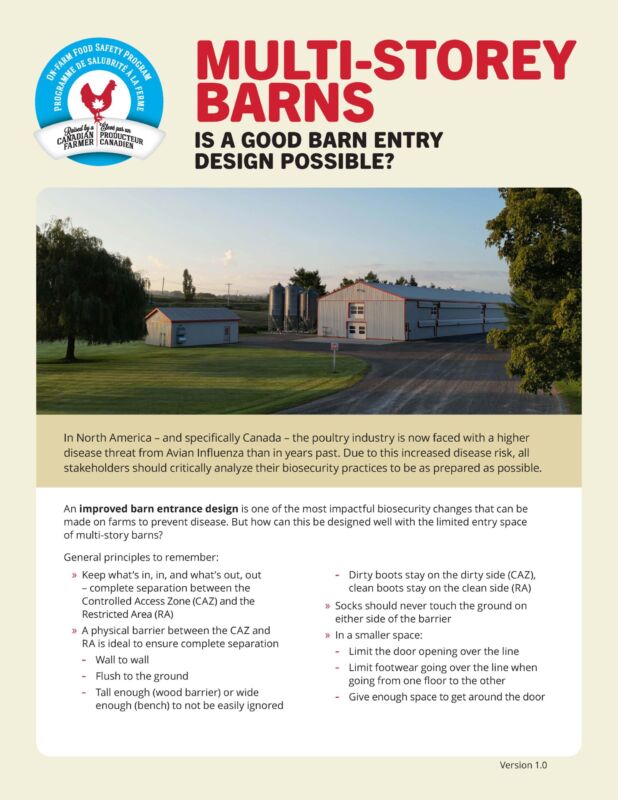
To help with this, a series of videos and factsheets are available that demonstrate the proper entrance protocol and different types of design options.